
Article
Future of Work
As a kid, I would learn clever strategies to solve math equations faster to be top of the class. Today, this would feel pointless. AI handles both computation and chain-of-thought problem-solving; so why bother?
I would bother because critical thinking is a core skill. Even when AI outperforms humans on several dimensions, either by simulation or by computation, the skills that (1) resist automation (2) defy simulation and (3) enhance AI-generated outputs, those core skills always win.
Systems thinking, for example, supersedes AI by using multiple agents to project manage, generate summaries and extract information from multiple links, databases, and handwritten notes.
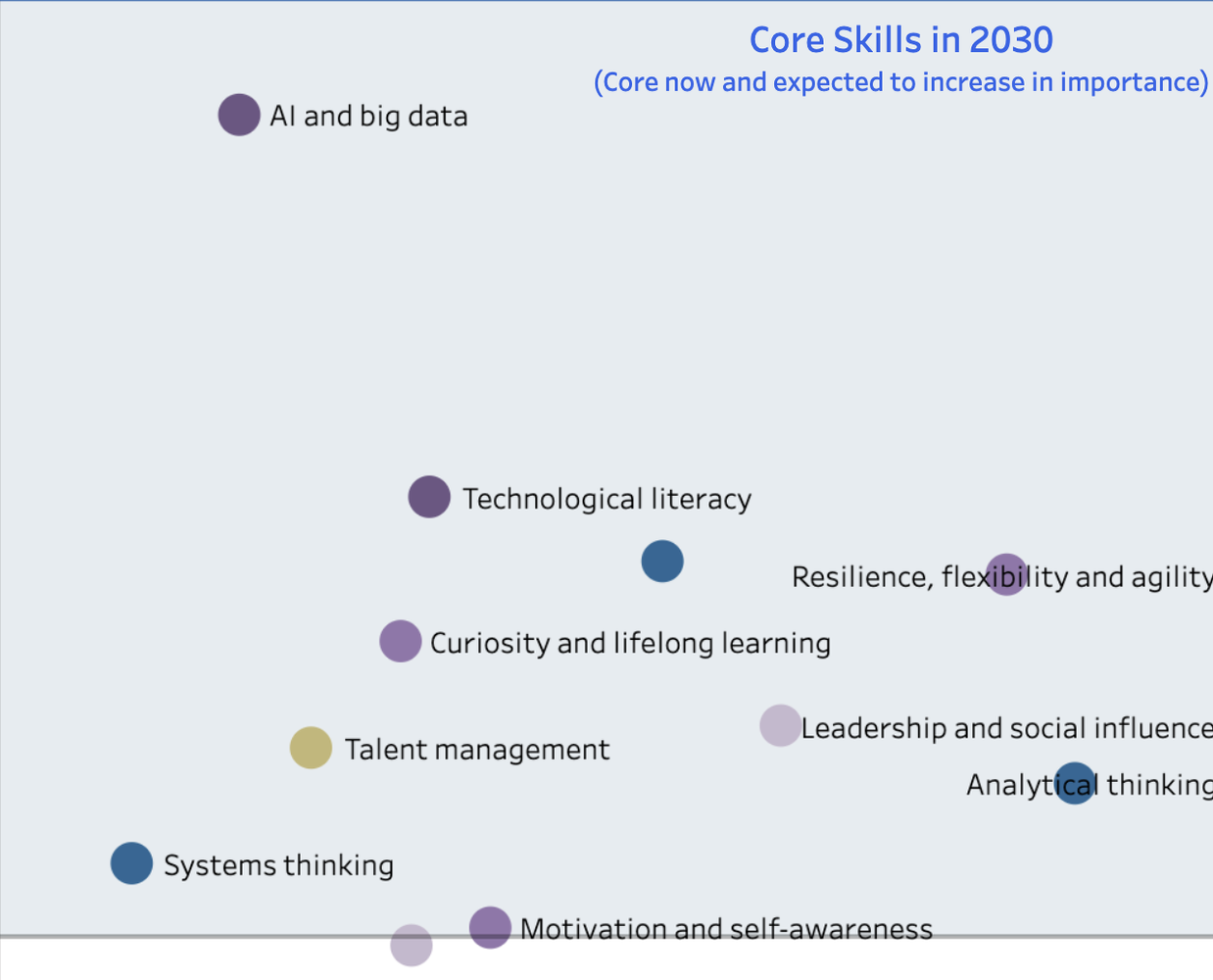

AI literacy is a top core skills, too, but not for reasons you might think. AI literacy is necessary and helpful, just like using a phone productively is necessary and helpful, as opposed to scrolling aimlessly.
You may ask then: 'What's so special about skills that resist automation, simulation, and probabilistic thinking?' The answer has to do with accountability, authenticity and striving for far higher-quality, if not more inclusive, sustainable, and meaningful results, than automation and probabilistic 'reasoning' can ever achieve.
Today, pre-trained generative models can simulate empathy by sputtering the most alluring and soothing next-best word. This is probabilistic response generation, not empathy nor inductive reasoning.
However, the simulation draws people in: from those building fast businesses on LLM wrappers to those who pay for LLM-generated research, friendship, and therapy.
Pre-trained generative models can stitch together one next-best word after another, pattern-matching logic, care, or expertise in a captivating way.
Together, they create the illusion of expertise, producing outputs that resemble, for example, high-quality, bulletproof business models for people driving in the fast lane of digital entrepreneurship. Some succeed. Others continue to pay the price of Gen AI extras in monthly subscriptions. You can't fake, automate, or send expertise elsewhere.
We have lost sight of our strengths and ingenuity, which take practice, not prompting. We are afraid, and we attack and slander AI, forgetting that, in reality, we attack and slander each other.
The expression "touch grass" reflects both a disillusionment with the failings of our digital world and a return to our humanity. We are having a comeback post-AI, and we like ourselves a bit more. We know real people tell captivating stories, gain irreplaceable experience over decades, make leaps in creative reasoning, and understand real-world problems. Humans are pretty cool.
So, when I say touch grass and use AI, I mean a few things:
I understand I cannot exchange deep expertise for LLM-generated general reasoning. However, I am certain I can improve upon my strengths, even those that only grow in the magical and messy garden of human ingenuity, like storytelling.